
Breast Cancer Treatment by Stage: A Complete Guide
Introduction
A breast cancer diagnosis can raise many questions, especially about what treatment comes next. One of the most important factors doctors consider when planning treatment is the stage of breast cancer. The stage describes how large the cancer is, whether it has spread to nearby lymph nodes, and whether it has spread to other parts of the body.
However, breast cancer treatment by stage is not the same for every patient. Treatment is also influenced by the type of breast cancer, hormone receptor status, HER2 status, tumour grade, genetic or molecular characteristics, overall health, age, menopausal status and personal treatment preferences.
Depending on the individual situation, treatment may include surgery, chemotherapy, radiation therapy, hormone therapy, targeted therapy, immunotherapy or a combination of these approaches.
Understanding Breast Cancer Stages
Breast cancer is generally classified from Stage 0 to Stage IV.
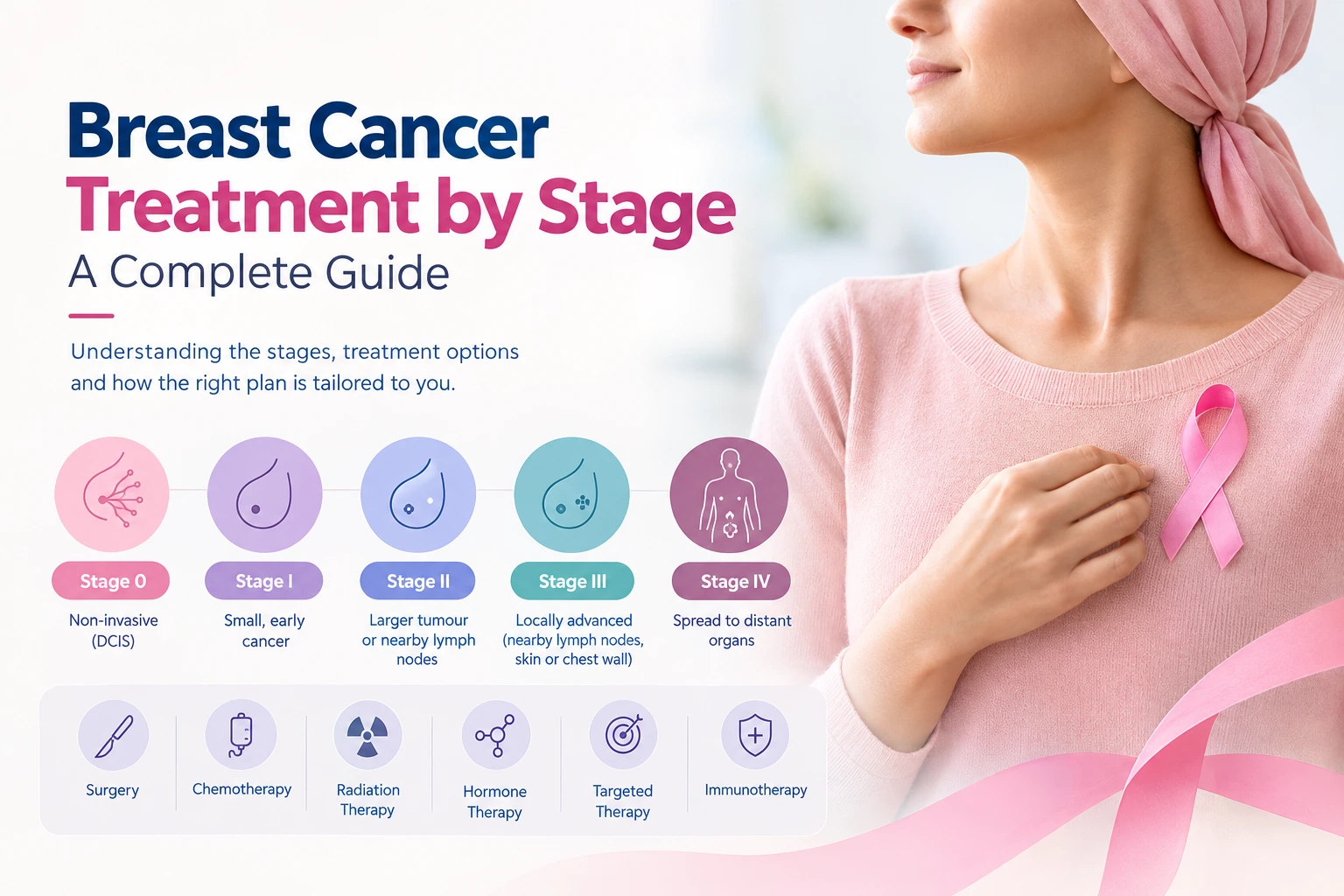
Stage | What it generally means | Common treatment approach |
Stage 0 | Non-invasive disease such as DCIS, confined to the milk ducts | Surgery, radiation and/or hormone therapy |
Stage I | Small, early breast cancer with limited or no lymph-node involvement | Surgery followed by selected additional treatments |
Stage II | Cancer is larger and/or has spread to nearby lymph nodes | Surgery and systemic treatment, with radiation when indicated |
Stage III | Locally advanced cancer involving nearby lymph nodes, skin or chest wall | Usually systemic treatment before surgery, followed by surgery and radiation |
Stage IV | Cancer has spread to distant organs | Systemic treatment, symptom control and long-term disease management |
The exact definition of each stage depends on tumour size, lymph-node involvement, distant spread and biological characteristics of the cancer.
Breast Cancer Treatment by Stage
Stage 0 Breast Cancer Treatment
Stage 0 commonly refers to ductal carcinoma in situ (DCIS). In DCIS, abnormal cells are confined to the lining of the milk ducts and have not invaded surrounding breast tissue.
Treatment may include:
- Lumpectomy: Removal of the area containing abnormal cells while preserving most of the breast.
- Radiation therapy: Often considered after breast-conserving surgery to reduce the risk of recurrence.
- Mastectomy: Removal of the breast may be recommended when DCIS is extensive or affects multiple areas.
- Hormone therapy: May be considered when the cancer cells have hormone receptors.
The choice depends on the extent and characteristics of DCIS and the patient’s individual circumstances.
Stage I Breast Cancer Treatment
Stage I breast cancer is generally considered early-stage disease. The cancer is relatively small and has not spread extensively.
Surgery is commonly an important part of treatment. Depending on the tumour’s size and location, surgery may involve:
- Breast-conserving surgery (lumpectomy)
- Mastectomy
- Sentinel lymph node biopsy to assess nearby lymph nodes
Radiation therapy is commonly recommended after breast-conserving surgery. Some patients who undergo mastectomy may also require radiation depending on the characteristics of the cancer.
Additional treatment depends heavily on tumour biology.
For example:
- ER-positive or PR-positive breast cancer may require hormone therapy.
- HER2-positive breast cancer may require HER2-targeted treatment.
- Chemotherapy may be considered when the cancer has characteristics associated with a higher risk of recurrence.
- Certain genomic tests may help determine whether chemotherapy is likely to provide meaningful benefit in selected hormone receptor-positive, HER2-negative cancers.
Therefore, a small tumour does not automatically mean that chemotherapy is unnecessary.
Stage II Breast Cancer Treatment
Stage II breast cancer may involve a larger tumour, nearby lymph nodes, or both.
Treatment can involve a combination of:
- Surgery
- Chemotherapy
- Radiation therapy
- Hormone therapy
- HER2-targeted therapy or other targeted treatment when appropriate
In some patients, treatment begins with chemotherapy or other systemic treatment before surgery. This is known as neoadjuvant therapy.
Neoadjuvant treatment can:
- Shrink the tumour before surgery
- Make breast-conserving surgery possible in some cases
- Treat microscopic cancer cells that may have travelled elsewhere
- Provide information about how the tumour responds to treatment
For HER2-positive or triple-negative breast cancers, treatment before surgery is commonly considered in appropriate patients because the response to initial therapy can help guide subsequent treatment.
After surgery, additional treatment may be recommended based on the surgical findings and tumour characteristics.
Stage III Breast Cancer Treatment
Stage III breast cancer is considered locally advanced breast cancer. It may involve multiple nearby lymph nodes or the skin or chest wall, without evidence of distant metastasis.
Treatment commonly involves several forms of therapy rather than relying on surgery alone.
A typical treatment sequence may include:
Systemic therapy → Surgery → Radiation therapy → Additional systemic treatment when required
Chemotherapy may be given before surgery to reduce the size and extent of the tumour. Depending on the cancer subtype, treatment before surgery may also include targeted or immunotherapy.
After the initial treatment, surgery may involve:
- Mastectomy
- Breast-conserving surgery in selected patients
- Removal or assessment of affected lymph nodes
Radiation therapy is generally an important part of treatment after surgery for stage III disease.
Inflammatory Breast Cancer
Inflammatory breast cancer is an aggressive form of breast cancer that can present with breast swelling, redness, warmth or skin changes. It is commonly treated as locally advanced disease when there is no distant spread.
Treatment generally requires a combination of systemic therapy, surgery and radiation therapy, with the exact plan depending on tumour biology and response to treatment.
Stage IV Breast Cancer Treatment
Stage IV breast cancer is also called metastatic breast cancer. It means the cancer has spread beyond the breast and nearby lymph nodes to distant parts of the body, such as the bones, liver or lungs.
The primary goal of treatment is usually to control the disease, slow its progression, manage symptoms and maintain quality of life. Some patients can live for many years with metastatic breast cancer when the disease responds well to treatment.
Treatment may include:
- Hormone therapy
- Chemotherapy
- HER2-targeted therapy
- Other targeted medicines
- Immunotherapy for selected breast cancers
- Radiation therapy to relieve symptoms or control specific areas
- Surgery in selected situations
- Clinical trials
The treatment selected depends substantially on the subtype of breast cancer, previous treatments, where the cancer has spread, how the cancer responds to treatment and the patient’s overall goals.
Why Hormone Receptor and HER2 Status Matter
Stage alone does not determine breast cancer treatment.
Doctors usually assess biomarkers including:
- Estrogen receptor (ER)
- Progesterone receptor (PR)
- HER2
Breast cancers that are ER-positive or PR-positive may respond to hormone therapy.
HER2-positive breast cancers may benefit from medicines specifically designed to target the HER2 protein.
Some breast cancers are triple-negative, meaning they do not have estrogen or progesterone receptors and do not have excess HER2. These cancers require a different treatment approach and may involve chemotherapy, immunotherapy or other treatments depending on the clinical situation.
Surgery, Chemotherapy and Radiation: What Is the Difference?
Breast cancer treatment can involve several different approaches.
Surgery
Surgery removes the visible cancer from the breast and may also involve assessment or removal of nearby lymph nodes.
Chemotherapy
Chemotherapy uses medicines that travel throughout the body to destroy or control cancer cells. It may be given before surgery, after surgery or as part of treatment for metastatic disease.
Radiation Therapy
Radiation uses high-energy radiation to destroy cancer cells in a specific area. It is commonly used after breast-conserving surgery and may also be recommended after mastectomy or for selected metastatic sites.
Hormone Therapy
Hormone therapy is used for hormone receptor-positive breast cancer. It helps reduce the ability of hormones such as estrogen to stimulate cancer growth.
Targeted Therapy
Targeted medicines act on specific characteristics of cancer cells. HER2-targeted treatment is an important example for HER2-positive breast cancer.
Immunotherapy
Immunotherapy helps the immune system recognise and attack cancer cells. It is used for selected breast cancer subtypes and clinical situations rather than routinely for every patient.
How Doctors Decide the Right Breast Cancer Treatment
Your oncologist may consider several factors before recommending treatment:
- Breast cancer stage
- Tumour size
- Lymph-node involvement
- ER and PR status
- HER2 status
- Tumour grade
- Genetic or molecular test results when appropriate
- Whether the cancer has spread to distant organs
- Previous treatment
- Age and general health
- Menopausal status
- Pregnancy considerations, when relevant
- Personal treatment preferences
This is why two people with the same breast cancer stage may receive different treatment plans.
Frequently Asked Questions About Breast Cancer Treatment by Stage
Can Stage I breast cancer require chemotherapy?
Yes. Stage I does not automatically mean that chemotherapy is unnecessary. The decision depends on tumour biology, size, grade, lymph-node findings and other factors.
Does Stage II breast cancer always require surgery first?
Not necessarily. Some patients receive chemotherapy or other systemic treatment before surgery, particularly when the tumour is larger or has biological characteristics that make neoadjuvant treatment appropriate.
Is Stage III breast cancer treatable?
Stage III breast cancer is locally advanced but may still be treated with an aim of achieving long-term disease control or cure in appropriate patients. Treatment often involves multiple modalities, including systemic therapy, surgery and radiation.
Can Stage IV breast cancer be treated?
Yes. Stage IV breast cancer can be treated. Treatment generally focuses on controlling the cancer, slowing its progression, relieving symptoms and maintaining quality of life. The treatment plan can change over time depending on how the cancer responds.
Conclusion
Understanding breast cancer treatment by stage can help patients and families understand why different treatments may be recommended at different points in the disease.
However, stage is only one part of the treatment decision. Modern breast cancer care considers tumour biology, ER and PR status, HER2 status, lymph-node involvement, tumour characteristics, genetic factors, previous treatment and the patient’s overall health.
If you or someone you know has been diagnosed with breast cancer, discuss the pathology, staging results and available treatment options with a qualified oncologist. A personalised treatment plan is essential because breast cancer can behave differently from one patient to another.
Contact Details:
Dr. Sachin Trivedi
Oncologist in Mumbai | Cancer specialist in Mumbai
Address: Bldg No. 38, N S Patkar Marg, opp. Westside, Babulnath, Dadi Sheth Wadi, Gamdevi, Mumbai, Maharashtra 400007
Phone: 83696 95209
Website: drsachintrivedi.com